


The Art of Disguise
In nature, survival depends on the ability to influence perception. Through camouflage and mimicry, organisms evolve not merely to hide, but to shape what others believe they are seeing. The relationship between predator and prey is therefore not only a physical struggle but an informational one. A contest over visibility, recognition and interpretation.
Today, this evolutionary dynamic has migrated into human society. In an environment saturated with cameras, algorithms, social media, and constant observation, invisibility has become increasingly difficult to achieve. Rather than disappearing from view, individuals develop new forms of camouflage by constructing identities, curating appearances, and strategically directing attention. Visibility itself becomes a medium that can be manipulated.
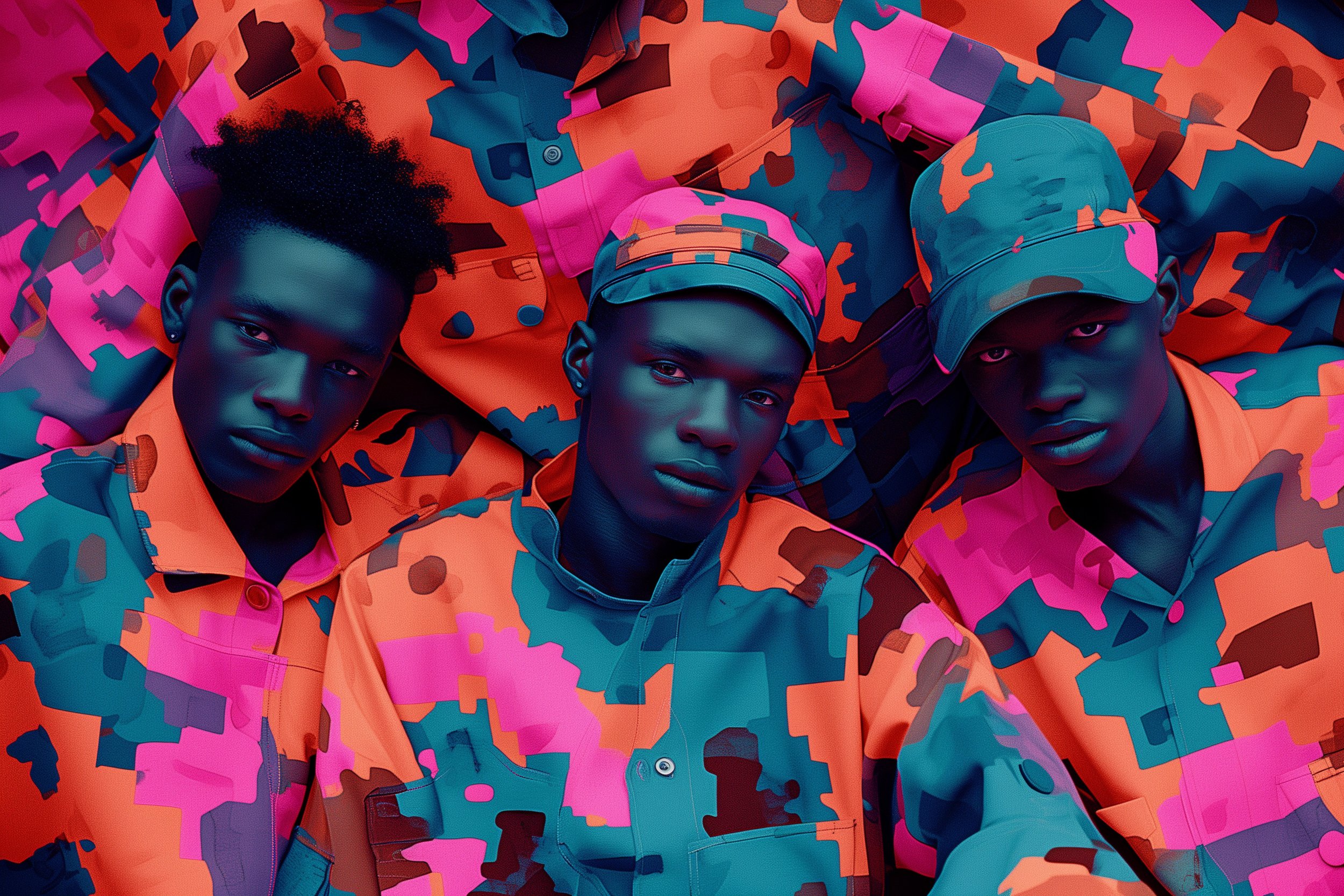
This study investigates camouflage not as a method of concealment, but as a technology of perception. Through disruptive patterns, visual noise, and exaggerated forms of visibility, the work explores a paradox: can standing out become a way of remaining unseen? Can excessive visibility obscure rather than reveal?
Drawing from biological adaptation this study examines how identity is performed and negotiated under conditions of continuous observation. The predator and prey no longer occupy fixed positions. Observers are simultaneously observed and those who seek visibility may also seek protection from it.
The work proposes camouflage as a contemporary condition rather than a natural phenomenon. In a world where hiding is increasingly impossible, survival may depend less on avoiding attention than on controlling how attention is directed, interpreted and remembered.


